

The 9-Shot Matrix
Hit 9 shots combining 3 trajectories (low, medium, high) and 3 shapes (draw, straight, fade) to build full shot control.
 Approach Intermediate ~5 min 4 difficulty levels
Difficulty levels
Setup & execution
Define all 9 shots: three trajectories (low, normal, high) × three shapes (draw, straight, fade). Pick any one iron and work through the grid. Spend 3–5 balls on each shot type before moving on. Track which of the 9 types you execute with confidence. A shot is 'executed' when 2 of 3 balls are representative of the intended shape and trajectory.
Goal
Execute 5 of the 9 shot types reliably to pass. Monthly tracking reveals your shot-making baseline.
Tour context
Mid-handicap players typically have 2–3 reliable shot shapes. Expanding to 5 of 9 enables on-course decision-making that saves 2–3 strokes per round by avoiding forced shots. This is Ben Hogan's original framework from Five Lessons (1957).
Scoring options
Pick how you are rewarded. Each option records different outcomes and feeds different insights.
Execution Grid
One point for every shot type you can actually execute.
Under Pressure
Call the shot out loud first. Failing it costs you double.
Opponent's Choice
Your partner picks the shot. Only clean execution scores.
Target Integration
The right shape scores; finding its target is a bonus.
Session Clean
Every shape in one unbroken session, or the card isn't clean.
More approach drills
All approach Approach
Iron Dispersion
Hit 15 iron shots across three target distances, using dispersion corridors from 10 yd to 30 yd wide depending on difficulty, and map whether each shot finishes in zone, left, or right.
 Approach
Three Targets
Hit five approach shots to each of three alignment-stick targets set at different distances — distances and scoring rings vary by difficulty tier from 50–175 yd. Mark a scoring ring around each stick before you begin and count any ball resting inside the ring as a success. Complete three rounds for 45 approach shots in total.
 Approach
Divot Board / Towel Contact Drill
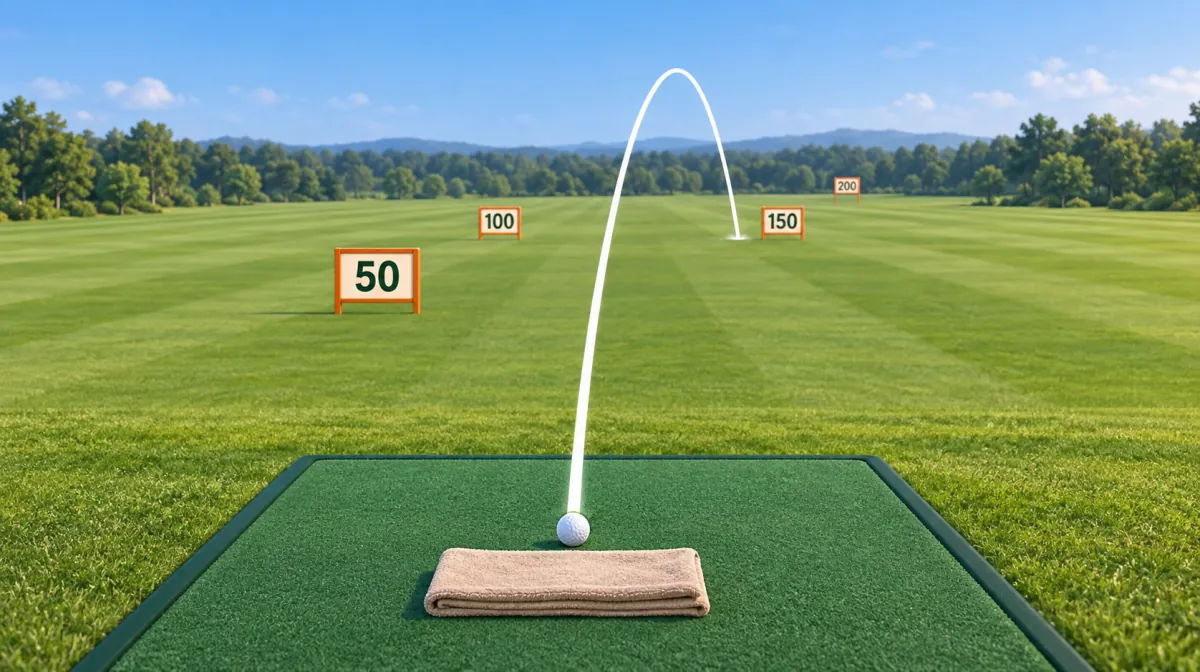
Place a towel behind the ball and strike irons without touching it, training ball-first contact and a forward divot.